How to Tell if a Pokémon Card Is Fake: 8 Checks That Work
October 31, 2026 · 4 min read
On this page
The quickest way to spot a fake Pokémon card is to compare it side by side with a verified image and a real card from the same era. Look for spelling errors, blurry energy symbols, off colors and flimsy card stock. One oddity may be a print variation, but several together strongly suggest a fake.

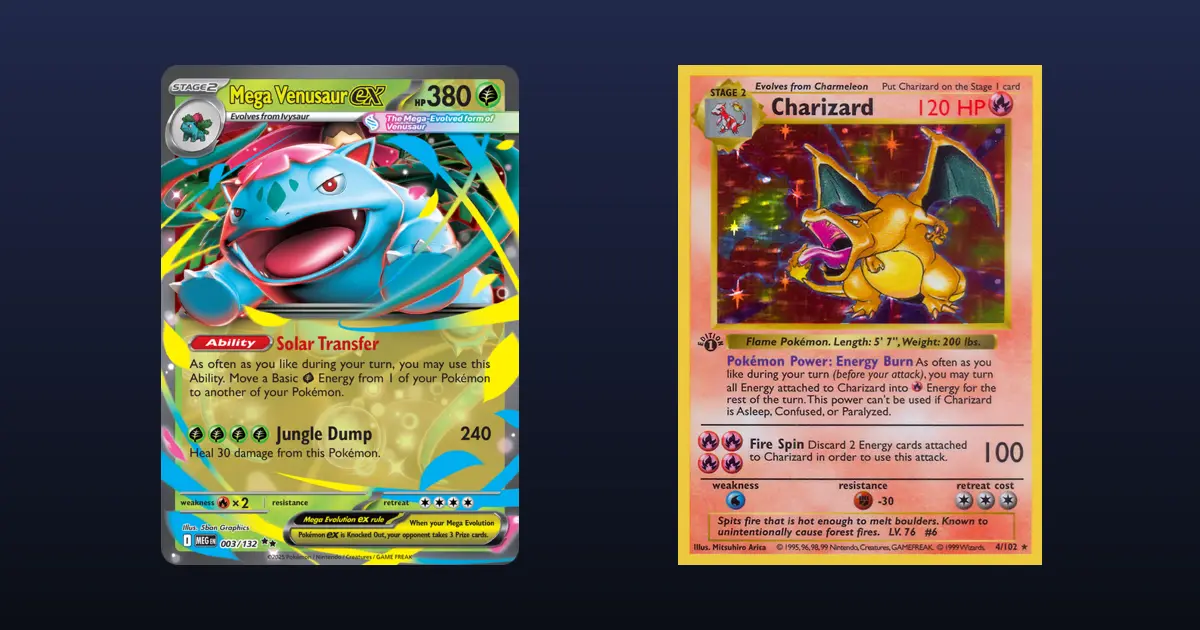
The numbers on this genuine card mark what to inspect on yours: (1) the name and HP, (2) the rules text, (3) the Energy symbols and attack, (4) Weakness, Resistance and Retreat, and (5) the set code, card number and rarity symbol, with the copyright line below.
8 ways to check a Pokémon card
- Compare it with a verified image. Search the set name and card number, then compare the art, text, attack names and damage. Any difference that isn't a known variant is a red flag. Our Pokémon pack opening simulator shows card images for recent sets if you need a quick reference.
- Read the text. Fakes often contain spelling mistakes, odd grammar or strange attack names. "Pokémon" should have its accent.
- Check the font. Lettering should be crisp and evenly spaced. Blurry, thick or uneven letters are a warning sign.
- Look at the Energy symbols. Real symbols are sharp and consistent. Fakes may be blurry, off-center or the wrong size.
- Check the back. Compare the shades of blue, the Poké Ball and the border with a real card. Washed-out, purple-tinted or too-dark backs are common on fakes.
- Compare the finish. Holo patterns should suit the card's era and type. Be suspicious if the whole card has a cheap all-over rainbow shine, or if a card that should be textured feels totally smooth.
- Feel the stock. Real cards are firm, with some snap. Fakes are often thin and bend too easily, or feel waxy and too glossy.
- Try the light test. Shine a phone light through the card next to a real one from the same era. If one lets through far more light, take a closer look. This is only a comparison, because different eras and finishes vary.
Use more than one check
Don't rely on a single test. Real cards can be off-center and have small printing flaws, and good fakes pass individual checks. It takes a pattern of problems to be sure, so if a card is valuable and you're still unsure, ask a trusted local game store or a grading company.
Don't tear a card to test it. Some guides suggest this, but it destroys the card even if it's real.
Red flags when buying
- The price is far below recent sales. Check what the card usually sells for first.
- Huge "sealed" lots of rare cards at low prices. Real packs don't come stuffed with hits.
- Only stock photos. Ask for clear photos of the front and back of the actual card.
- A new seller with no history. Check feedback, and pay with a method that offers buyer protection.
- Tins and packs with odd wrapping. Sealed products can be fake or resealed too, so buy from known retailers.
Are graded cards always real?
Not automatically, as fake slabs exist. For a graded card, look up the certification number on the grading company's website, and compare the card and label details with the official record.
What to do with a fake card
If you bought it as genuine, contact the seller or marketplace quickly and use its buyer protection process. Keep the listing, messages and photos. Don't resell it as real.
FAQ
Are Pokémon cards with no accent on the "e" fake? It's a strong warning sign on a modern English card, but check the other points too.
Do fake Pokémon cards have holo? Many do. A shiny finish doesn't prove a card is real, as the pattern matters more than the shine.
Is there an app to check Pokémon cards? Card scanner apps can identify a card and show a reference image, but that doesn't prove a physical card is real. Treat them as a starting point.
Can real Pokémon cards be miscut? Yes. Off-center and miscut cards do exist, so a bad border alone doesn't prove anything.
Pokémon artwork and card images © Nintendo, Creatures, GAME FREAK and The Pokémon Company. mgame.gg isn't affiliated with or endorsed by them.